


Are you wondering about releasing music independently, or do you have music releases already out that you are looking to transfer? Your choice of distributor becomes much more important than most artists normally realise. A distributor is not just a place where you upload songs so they appear on Spotify or Apple Music and many other streaming platforms globally. It becomes part of your main music business, controlling how your revenue flows and how your metadata is handled, how reliable your release process is, and, in some cases, how effectively you can scale your music release catalogue over time. Choosing the wrong distributor can create frustration over time with payment uncertainty and growth limitations, while the right one can quietly support your career for years without becoming a problem you have to solve later.
I have seen most comparison articles simplify this decision too much. They tend to compare pricing tables, list features, and then declare a winner. But in theory, artists rarely fail because they chose a distributor with one less feature. Some artists struggle because they chose a platform that did not match how they actually work, how often they release or how seriously they treat the business side of music. A better comparison, therefore, looks beyond surface features and instead focuses on structure, reliability, maturity, and long-term usefulness.
This is why I looked into Symphonic, DistroKid, and TooLost from that more practical perspective. Instead of focusing on marketing claims, it looks at how these platforms differ in philosophy, what type of artist they are realistically built for, and where each one introduces either advantages or trade-offs depending on your goals.
Understanding the real differences between these distributors
One of the easiest ways to understand these three platforms is to recognise that they are not really direct copies of each other. They may all distribute music, but they were built with very different priorities in mind. This is important because many artists assume all distributors are basically the same with slightly different pricing, when in reality, they often represent completely different approaches to the independent music industry.
Being part of Symphonic, I have seen that they operate much closer to what could be described as a service distributor with a wider support for artists' growth. Offering an infrastructure that goes beyond basic distribution and into areas like rights management and revenue optimisation. DistroKid sits on the opposite side of the spectrum, functioning more like a software platform designed to remove friction and allow artists to release as quickly and cheaply as possible without much human involvement. TooLost sits somewhere between these approaches, representing a newer generation of platforms aiming to compete through technology, analytics, and platform reach rather than legacy reputation.
Understanding this difference alone already simplifies the decision process for yourself, because it changes the question from which distributor is best to choose to which distributor matches how I plan to operate as an artist.
Symphonic Distribution
Built for artists thinking beyond just releasing songs
Symphonic Distribution feels fundamentally different from most entry-level distributors because it operates more like a service organisation to support artists' growth than a pure technology platform. While they do offer standard distribution access, their broader focus clearly sits around artist development infrastructure with publishing administration, rights collection, marketing support, and revenue expansion opportunities that many smaller artists often overlook. This suggests their model is built around long-term artist relationships rather than purely volume-based subscriptions.
This may appeal more to artists who see their music as a long-term asset rather than just a series of releases. If you are thinking in terms of building a catalogue, maximising revenue channels, or potentially expanding into licensing and publishing revenue, a distributor with this type of structure starts to make more sense. Their role becomes less about simply delivering files to platforms and more about helping manage the business mechanics behind a growing body of work.
Another area where Symphonic stands out is operational maturity. Compared to newer platforms, they feel more structured, like a traditional distributor that has adapted to independent artists rather than a start-up trying to automate everything from the beginning. This often shows in their support structures, their industry relationships, and the way they position themselves as a partner rather than just a tool. For artists who value stability and predictability, this kind of maturity can matter more than having the newest dashboard features.
That said, this same business structure can also introduce more friction compared to faster self-service platforms. Workflows may feel slightly heavier, processes may be more structured, and some higher-level services require approval rather than instant access. This is not necessarily a weakness. It is simply the trade-off that usually exists between platforms built for speed and platforms built for stability. Artists who just want to release songs quickly may find this unnecessary, while artists thinking five years ahead may see it as reassurance.
Symphonic Pricing
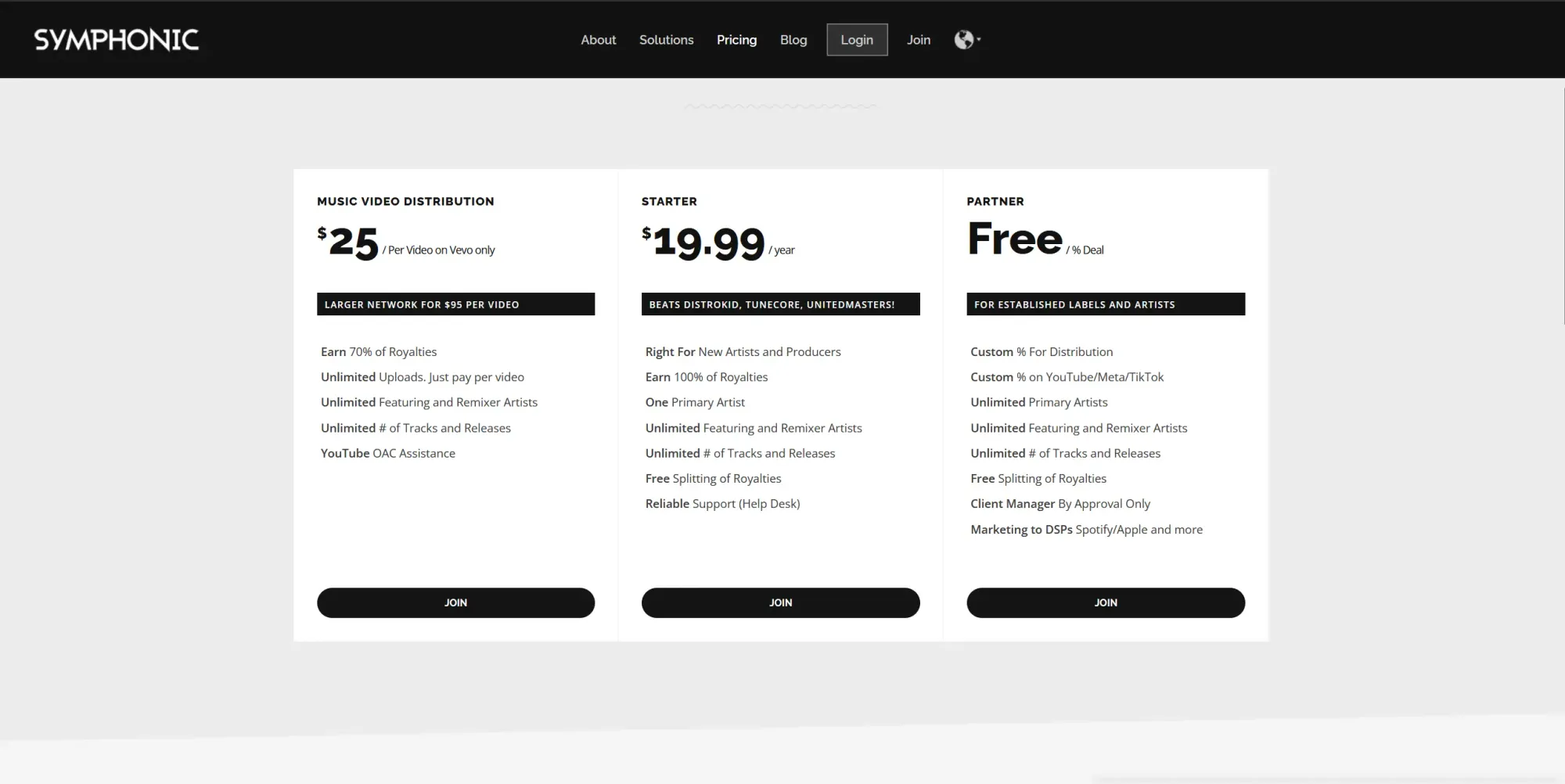
Symphonic Distribution offer $19.99 USD for a starter. This is aimed at new artists and producers to get started. This fee is charged per year.
Symphonic also offers a partner program, for which you have to submit an application for review. This is aimed at more established labels and artists. They do a royalty split at usually 15% for symphonic distribution cut of the earned royalties, but this can vary depending on the contract signed with them.
Symphonic has another option for music video distribution, which is $25 USD per video on Vevo only at this time, for which you will earn 70% of the royalties collected.
DistroKid
A distribution platform designed around efficiency and independence
DistroKid has become one of the most widely used distributors largely because it understands exactly what it wants to be. Rather than trying to become a service partner or a marketing platform, it focuses almost entirely on being an efficient infrastructure for independent artists. Its entire design reflects this philosophy, from its fast upload processes to its simple pricing structure and emphasis on automation rather than consultation.
This software's first mindset is a large part of its appeal. For artists who already understand how distribution works and do not need guidance, DistroKid removes almost all unnecessary friction from the process. You pay a recurring yearly fee, you can release as much music as you want, and the platform largely stays out of your way. For many independent musicians, especially those releasing consistently, this simplicity is exactly what they need.
Where DistroKid performs particularly well is in predictability. I have seen that the costs are straightforward, the workflows are consistent, and releases tend to move through the system quickly to live music releases on streaming platforms and stores globally. This reliability makes it attractive not just to musicians but also to small independent labels and producers managing multiple artists, because the operational side becomes very easy to manage.
Its limitations are also predictable because they stem directly from this automation-first approach. Support tends to be more limited than service distributors because the platform assumes a level of independence from its users. Marketing support is minimal because that is not the problem DistroKid is trying to solve. Some useful tools exist as paid add-ons rather than standard features because the business model is based around keeping the base subscription simple.
None of these is necessarily a flaw. They are simply the result of a platform that chose to optimise for efficiency rather than support. For self-managed artists, that trade-off often makes perfect sense.
DistroKid Pricing
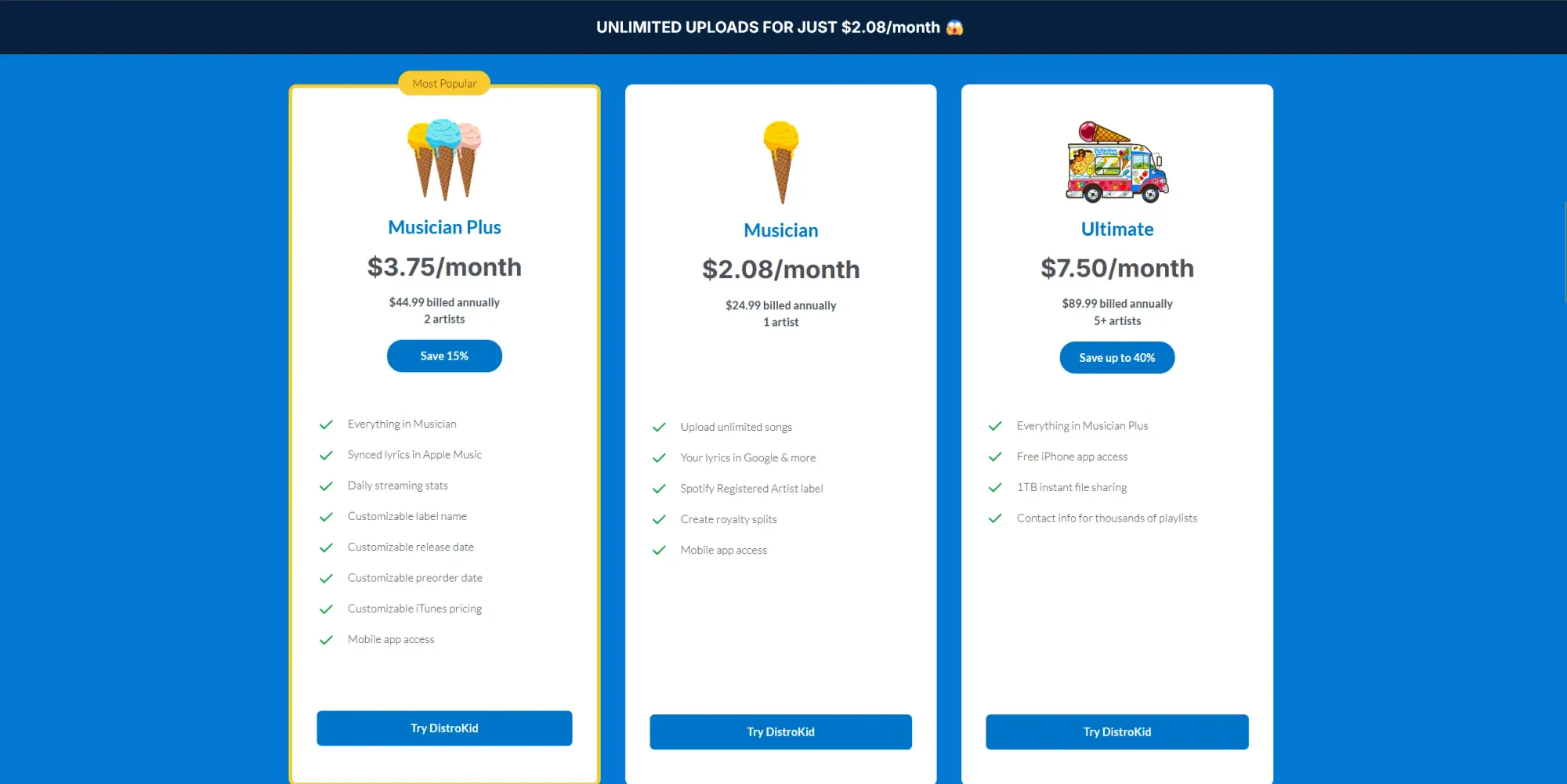
DistroKid offer a flat fee per year to upload unlimited music to major platforms, with plans at $24.99 USD per year for one artist, though they have higher rates for musicians, plus at $44.99 USD per year for two artists. Then, finally, the Unlimited plan at $89.99 USD per year for five or more artists.
You will retain 100% of earned royalties, apart from 20% Youtube Content ID fee.
DistroKid Additional Costs:
Distrokid do have more charges when it comes to extras, which are optional.
Cover Song Licensing:
$12 USD per cover per year
Discovery Pack:
$0.99 USD per song per year
Store Maximizer:
$7.95 USD per album per year
Social Media Pack:
$4.95 USD per single per year or $14.95 per album per year plus 20% of the ad revenue.
Beatport:
$9.99 USD per month
Leave a Legacy:
$29.00 per single, $49.00 per album of 2+ tracks (nonrecurring fee)
Dolby Atmos:
$26.99 per track (nonrecurring fee)
Loudness Normalisation:
$2.99 per track one-time fee (nonrecurring)
TooLost
A newer platform trying to compete through technology and ecosystem design
TooLost represents a slightly different direction compared to both Symphonic and DistroKid because it appears to be trying to compete through platform capability rather than history or pure simplicity. Their messaging focuses heavily on distribution reach, analytics visibility, monetisation tools, and catalogue management features, suggesting they are attempting to build a more complete ecosystem rather than just a delivery mechanism.
This is a logical direction for newer distributors because competing directly on reputation against long-established companies is difficult. Instead, newer platforms often try to differentiate themselves by offering better dashboards, more data visibility, or broader integrations. From a technical perspective, this approach makes sense because independent artists are becoming increasingly data-aware and interested in understanding how their music performs across platforms.
Where TooLost looks promising is in the breadth of what they are trying to build. Their platform appears designed not just for individual artists but also for people managing catalogues, which suggests a slightly more scalable mindset than some entry-level distributors. Their analytics focus may also appeal to artists who like understanding performance trends rather than just checking revenue totals.
The main consideration with any newer distributor is usually not features but maturity. Established distributors have had years to refine processes, build trust, and stabilise support operations. Newer companies inevitably go through phases where support systems are still scaling and processes are still being refined. This does not mean they are unreliable, but it does mean artists choosing them are often early adopters rather than conservative operators.
For some artists, this is perfectly acceptable. Especially those who like testing newer tools or who value analytics and platform reach enough to accept slightly higher uncertainty compared to older companies.
TooLost Pricing
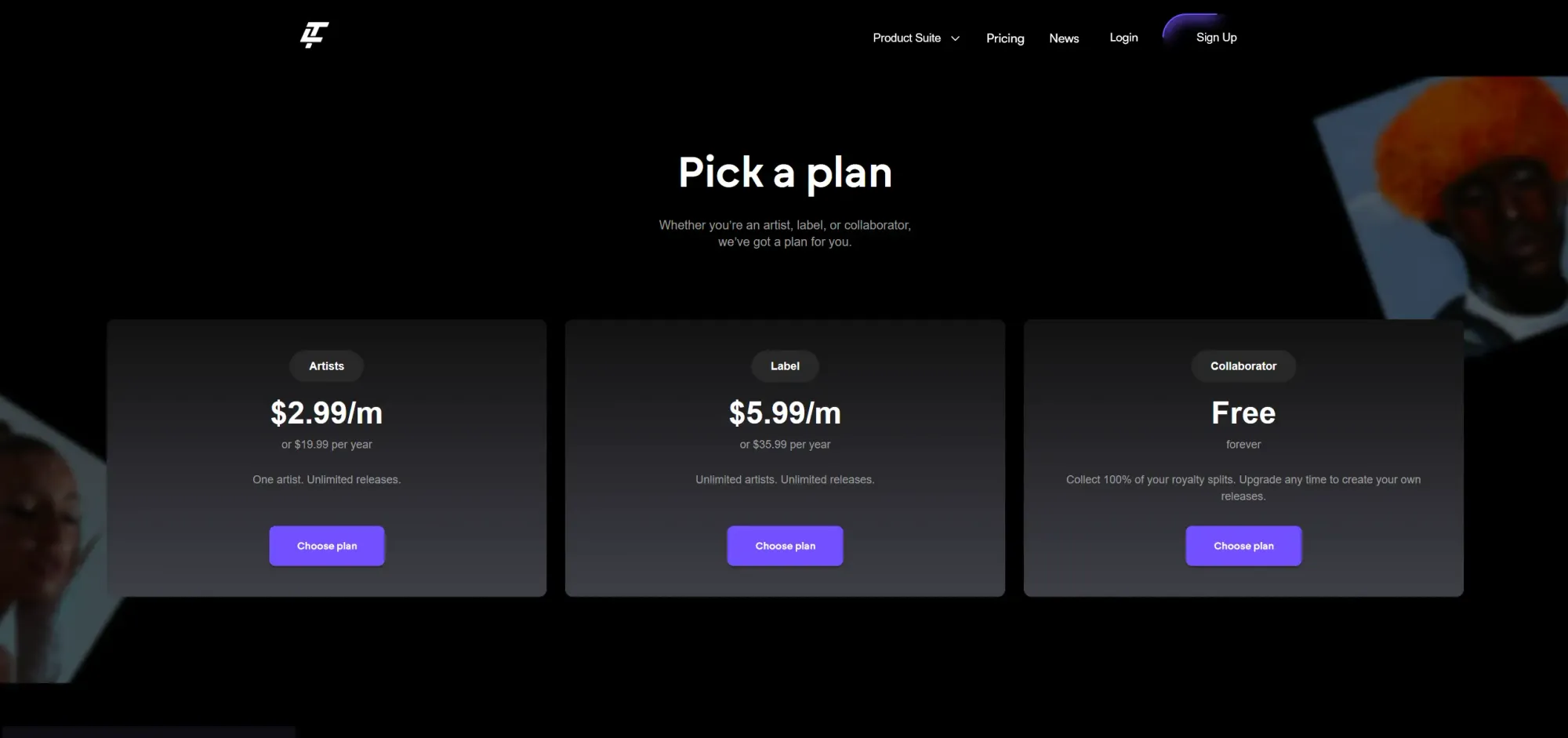
TooLost offers flat fees per year. If you only need one artist and unlimited releases, they offer the artist's plan at $2.99 USD per month or $19.99 USD per year. For unlimited artists and unlimited releases, they offer the label plan for $5.99 USD per month or $35.99 USD per year.
If you are collaborating with an artist already on TooLost, you can create a free collaborator account to collect 100% of your royalty splits with an option to upgrade later down the line if you wish to have your own releases.
TooLost Additional Costs
Cover Song Licensing:
$14.99 USD per song

Final comparison and realistic decision-making
Looking at these three distributors side by side makes it clear that they are not really competing on the same dimension. Symphonic is competing on depth of service and long-term infrastructure. DistroKid is competing on efficiency and cost-effectiveness. TooLost is competing on platform capability and technical direction.
This makes the decision less about which one is objectively better and more about which one matches how you approach your music. Artists releasing frequently and managing everything themselves often benefit most from the simplicity of DistroKid. Artists trying to build sustainable careers with multiple revenue streams may benefit more from Symphonic. Artists interested in data visibility and newer platform capabilities may find TooLost interesting enough to justify trying.
The mistake many artists make is choosing based on what other artists are using rather than what their own workflow actually requires. Distribution works best when it quietly supports how you already operate rather than forcing you to adapt to it.
Conclusion
All three platforms are legitimate and capable of distributing music professionally. The difference is not quality as much as focus. Each one is solving a different problem within independent music distribution, and understanding that makes the choice much clearer.
Symphonic makes the most sense for artists who see their music as a long-term business asset and want infrastructure that supports growth beyond just releasing songs. DistroKid makes the most sense for artists who want maximum efficiency and minimal operational overhead. TooLost makes the most sense for artists interested in modern platforms and willing to explore newer ecosystems that may evolve quickly.
In the end, the best distributor is usually not the one with the longest feature list. It is the one that fits naturally into how you already work and allows you to focus on making music rather than managing your distribution.
And in most cases, that alignment matters far more than any individual feature comparison ever will.


