


There are some plugins you buy because they open up a whole new world of sound design, and then there are plugins you keep because they quietly solve a problem you run into again and again. Kickstart 2 sits firmly in the second category for me.
If you make dance music long enough, you eventually end up paying a lot more attention to movement, groove, and space than you did at the start. In the early days, sidechain was usually just something I knew I needed. It helped the kick push through, it created a bit of bounce, and it made the low end breathe more clearly. That was enough. Over time though, I started to care less about the idea of sidechain as a box to tick and more about what it was actually doing to the track.
That is where a plugin like Kickstart 2 becomes useful. It is not trying to be everything. It is not pretending to replace every other dynamic tool in your session. What it does is give you a fast, musical, and very direct way to shape pumping and movement without overcomplicating the job. Sometimes that kind of plugin ends up being more valuable than something with a huge feature list, because you actually use it.
I use Kickstart 2 sometimes in my own productions, especially when I want to get a track moving quickly without breaking the flow. It is not the only way to handle this kind of job, and I would not pretend it is. But for what it is designed to do, it is very good at staying out of the way while still making a clear difference.
What Kickstart 2 actually is
Kickstart 2 is a sidechain-style volume shaping plugin from Cableguys and Nicky Romero. At a basic level, it gives you that familiar ducking and pumping effect that so much electronic music relies on, but it does it without needing you to set up a compressor, route a kick to a sidechain input, and fine-tune threshold and release settings just to get the groove moving.
That is the part that makes it appealing straight away. You load it, pick the shape, adjust the timing, and you are already moving. If the track needs a little more breathing room, a little more push, or a little more of that bounce between the kick and the rest of the mix, you can hear it almost immediately.
That speed matters more than people sometimes admit. A lot of production decisions are not really about whether you can technically achieve something. They are about whether the route to that result helps you stay creative or slows you down so much that you lose the point of what you were making. Kickstart 2 is one of those tools that tends to keep things moving.
Why a plugin like this still matters
There is always someone ready to say you can do the same thing with stock tools, and technically they are right. You can set up sidechain compression in most DAWs. You can use volume automation. You can build an equivalent chain if you really want to. The question is not whether it is possible. The question is whether it is efficient, repeatable, and musical enough for the way you work.
This is where Kickstart 2 earns its place for me. It removes friction. I do not need to stop and build a whole routing setup just to test whether the groove feels better with a little more movement in the bass or the pad. I can hear it almost straight away. That means I can make the production decision while I am still in the middle of the track, not after I have already lost momentum.
That is one of the biggest differences between a useful plugin and a plugin that just looks impressive. Useful plugins reduce resistance. They shorten the distance between the idea in your head and the result in the speakers. When you make harder dance music, that matters a lot, because energy and movement are not decorative parts of the track. They are part of the foundation.
What I like about Kickstart 2 in practice
The biggest strength of Kickstart 2 is how immediate it feels. You are not buried in controls. You are not stuck setting up an overcomplicated chain when all you actually need is cleaner movement between elements. The plugin gives you a direct visual shape, straightforward control, and a result that is easy to hear in context.
I like plugins that make it obvious what is happening. That sounds simple, but it matters. When a plugin is too vague or too packed with options, it becomes slower to trust. Kickstart 2 is the opposite of that. It is obvious. You can see the ducking shape, feel what it is doing, and quickly decide whether it is helping the groove or not.
That also makes it a useful writing tool, not just a mixing tool. There are times when the pumping itself is part of the emotional or rhythmic identity of the track. In those moments, I do not want the process of creating that movement to become a distraction. I want it to be fast enough that I can stay focused on the bigger picture.
Where it fits in dance music especially well
For me, Kickstart 2 makes the most sense in styles where movement and low-end control are central to the track. That includes harder dance music, Hardcore, Trance, and wider EDM. In all of those genres, the relationship between the kick and the rest of the mix is one of the key things that makes the track feel alive rather than flat.
If the bass is crowding the kick, the groove collapses. If the pads or leads are sitting too heavily over the drums, the energy gets blurred. If the ducking is too soft, the track can feel like it never really lifts. If it is too aggressive, it starts sounding gimmicky or tiring. That balance matters, and Kickstart 2 is useful because it lets you dial that feeling in quickly without turning it into a technical chore.
That is especially helpful when building tracks where the kick needs to stay in command. In a lot of harder music, the kick is not just a timekeeper. It is part of the character of the whole production. If everything else in the mix is fighting it, the track loses authority. A plugin like Kickstart 2 helps carve that authority back out cleanly.
What is improved in Kickstart 2 compared to older sidechain workflows
One thing I appreciate about Kickstart 2 is that it feels more refined than the old approach of relying on a compressor sidechain for everything. Compressor sidechain works, but it can also feel a bit clumsy when you want predictable movement. The response depends on the source, the threshold, the compression settings, and the way the signal is hitting the detector. Sometimes that is exactly what you want. Sometimes it is not.
With Kickstart 2, the movement is more intentional. You decide the shape and timing rather than reacting to a signal in a more indirect way. That gives you consistency. In many cases, consistency is more useful than technical purity, especially if what you are really after is a reliable musical bounce rather than a dynamic effect that varies every time the source changes.
That is not to say it replaces sidechain compression entirely. It does not. They solve slightly different problems. Traditional sidechain compression still makes sense in certain mixing situations. Kickstart 2 just gives you a faster and often more musical route when the goal is defined movement.
How I tend to use it
I do not use Kickstart 2 on everything, and I think that is worth saying clearly. I am not interested in treating any plugin like a religion. I use it when it solves the problem better than the alternatives and when it helps the track move in the right way.
Sometimes that means using it on bass to instantly create separation around the kick. Sometimes it means applying it to pads or layered synths so the track breathes more naturally. Sometimes it is useful on effects or background textures where I want subtle movement rather than obvious pumping. The point is not that it has one fixed use. The point is that it is flexible enough to solve the same kind of movement problem in different parts of the arrangement.
What I like is that I can hear the result quickly and decide whether it is helping the record. That is usually how I judge plugins anyway. Not by whether they have a massive spec list, but by whether they help me make a better decision while I am actually working.
Why workflow matters more than people admit
A lot of production bottlenecks are small on paper and huge in practice. Sidechain setup is one of those things. You can always tell yourself it only takes a minute to route properly or to set up an equivalent chain, but those minutes stack up, and more importantly, they break momentum. They pull you out of listening mode and push you into admin mode.
That is one reason I keep coming back to plugins that make a workflow easier without dumbing it down. I do not want everything automated for me. I do want to remove repetitive friction where it is not helping the art. Kickstart 2 does that well. It gives me direct control over movement in a way that feels musical, fast, and easy to judge inside a mix.
That kind of speed matters even more if you are juggling a lot of creative decisions at once. In a track where I am already thinking about kick design, arrangement, bass space, melodic tension, and how the drop should feel, I do not want a simple pumping decision to become the thing that slows the whole session down.
Where it is strongest
I think Kickstart 2 is strongest in three areas.
First, it is strong as a writing tool. If you are still shaping the groove and need to hear what the track feels like with movement, it gets you there immediately.
Second, it is strong as a cleanup tool. If something is sitting too heavily around the kick and making the mix feel static, it can clear that space quickly and musically.
Third, it is strong as a confidence tool. There is value in loading something and knowing you will get a reliable result without a lot of extra thought. That kind of confidence is useful, especially when you are moving quickly and want to stay focused on the track rather than the process around it.
Where I would not oversell it
At the same time, I do not think Kickstart 2 should be oversold as some magical answer to all sidechain or low-end problems. It is not. If your kick and bass choice are wrong at the source, no sidechain plugin is going to fix the deeper issue. If your arrangement is crowded, pumping alone will not make it feel clean. If your sound selection is weak, movement will not magically create identity.
This is one of the things I always try to keep in mind when talking about tools. A plugin should solve a defined problem. It should not become a substitute for judgement. Kickstart 2 is good because it solves a specific problem well. It does not make the bigger production decisions for you, and that is fine.
In a way, that honesty is part of why I like it. It is not pretending to be an all-in-one miracle. It is a focused tool that does what it says it does, and for the right workflows that is more valuable than something trying to be too many things at once.
How it compares to more complex tools
There are definitely more advanced plugins out there if you want deep custom modulation, highly complex routing, or extreme control over every part of the movement. If that is your thing, and if that is genuinely how you like to work, you may prefer those. But more advanced is not always better in day-to-day production.
For me, there is always a balance between depth and usability. A plugin can be technically brilliant and still not become part of my normal workflow if it slows me down or makes routine tasks feel heavier than they need to be. Kickstart 2 wins points because it sits on the useful side of that line. It gives enough control to matter without turning a simple musical decision into a technical exercise.
Does it fit a Narvuk-style workflow?
Yes, I think it does, which is why I still use it sometimes. My workflow has gradually shifted more and more towards tools that help me stay in motion. That does not mean I want everything simplified to the point of laziness. It means I want tools that make sense, tools that let me hear the result quickly, and tools that do not break the creative thread every time I need to solve a small but important problem.
That is exactly the kind of role Kickstart 2 fills. It is not one of those plugins I open because I am trying to impress myself with complexity. I open it because I know what I need from it, and I know it can get me there quickly.
That is often the mark of a plugin that has real staying power. It becomes part of the workflow because it makes the work feel cleaner, not because it makes the plugin folder look better.
Who I think Kickstart 2 is for
I think Kickstart 2 makes the most sense for producers who work in rhythm-driven music and value speed, clarity, and movement. That includes a lot of people in EDM, Trance, Hard Dance, Hardcore, House, and adjacent styles. If your tracks rely on groove and space around the kick, there is a good chance you will get something useful out of it.
It also makes sense for people who are tired of overcomplicating sidechain just to get a basic pumping feel going. If you like your tools direct, visual, and easy to trust, this plugin will probably make more sense than a more technical route.
On the other hand, if you already have a sidechain method you love and never feel slowed down by it, then Kickstart 2 might just be a nice-to-have rather than something essential. That is perfectly fine. I do not think every good plugin has to be universal.
My honest opinion
My honest view is that Kickstart 2 is a very good plugin for what it is meant to do. It is fast, clear, musical, and practical. It solves a common production problem without making the solution feel heavier than the problem itself.
That matters more to me than hype. Plenty of tools can produce impressive results if you spend enough time on them. What I value is whether a tool earns its place by helping me work better, move faster, and make stronger production decisions in context. Kickstart 2 does that when I need it.
It is not some all-powerful plugin that changes everything. It is something more useful than that. It is a reliable workflow tool that helps shape movement quickly and cleanly, and in dance music that can make a real difference.
Official Link
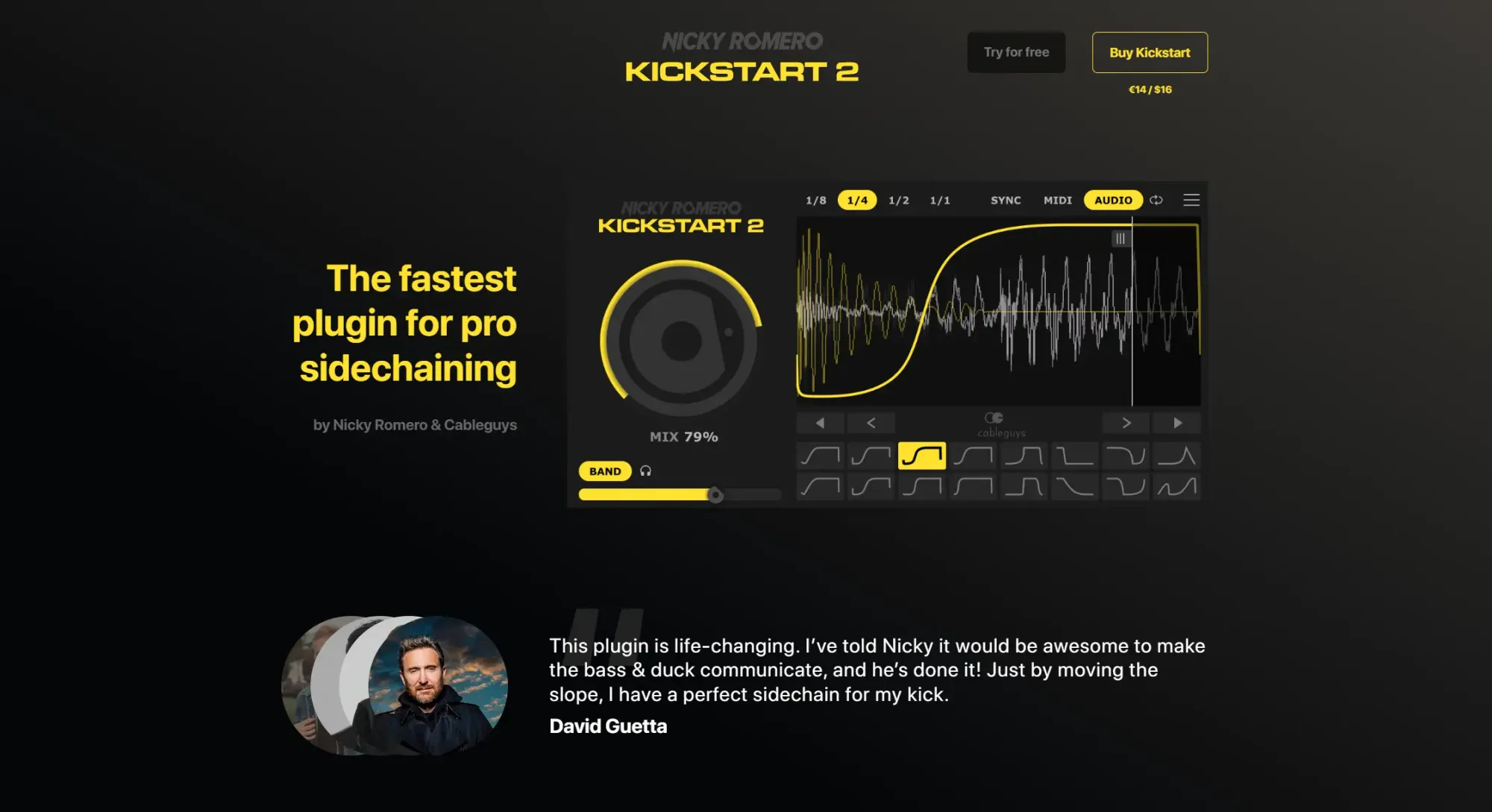
Kick Start 2 Vst Plugin
If you want to check the official page, learn more about the plugin, or buy it directly, you can use the links below.
Final thoughts
Kickstart 2 is one of those plugins that makes the most sense when you stop thinking about features and start thinking about friction. If you want an easy, musical, and dependable way to create sidechain-style movement without slowing down, it does the job very well.
That is why it still has a place in my workflow sometimes. Not because I need it on every track, and not because there are no alternatives, but because it does exactly what it should do with very little resistance. In production, that kind of efficiency matters.
If you work in Hardcore, Hard Dance, Trance, or any other groove-driven style where movement around the kick matters, Kickstart 2 is definitely worth a look.
If you want to see how it compares with other tools I use, it also makes sense alongside posts like Why I Started Using Kick 3 Instead of Relying on Kick Samples, Best Plugins I Actually Use for Hard Dance, Hardcore and Trance, and What I Look for in a Plugin Before It Earns a Place in My Workflow.


