


Some plugins impress you immediately because they are flashy, huge, or loaded with features. Others earn their place more quietly by sounding right the moment you lean on them in a real track. For me, Diva has always been much closer to the second type. It is not the newest synth in my workflow, and it is not the one I would describe as the most futuristic, but it is still one of the instruments I reach for when I want warmth, depth, weight, and a sense that the sound already has character before I start overworking it.
That is a big reason I think Diva still deserves serious respect in 2026. There are a lot of newer synths around now, and some of them are faster, broader, or more obviously modern in their interface and feature set. But there is still something about the way Diva sits in a mix that makes it hard to ignore. When I want a part to feel fuller, more alive, or more emotionally convincing, it often gets me there faster than synths that look more advanced on paper.
I use a few different tools for different reasons. Serum 2 is brilliant when I want speed, clarity, and flexible modern sound design. Pigments has a lot going for it if I want broader creative exploration. Nexus is still useful when I want polished sounds quickly. But Diva fills a different role for me. It is one of the synths I turn to when I want a sound to feel rich and believable rather than just functional.
That matters a lot in dance music and harder styles because not every part of a record needs to be clinical or aggressively sharp. Sometimes what makes a track feel bigger is the presence of something warmer, thicker, and more human in the middle of all the impact. Diva is very good at that.
What Diva actually does well
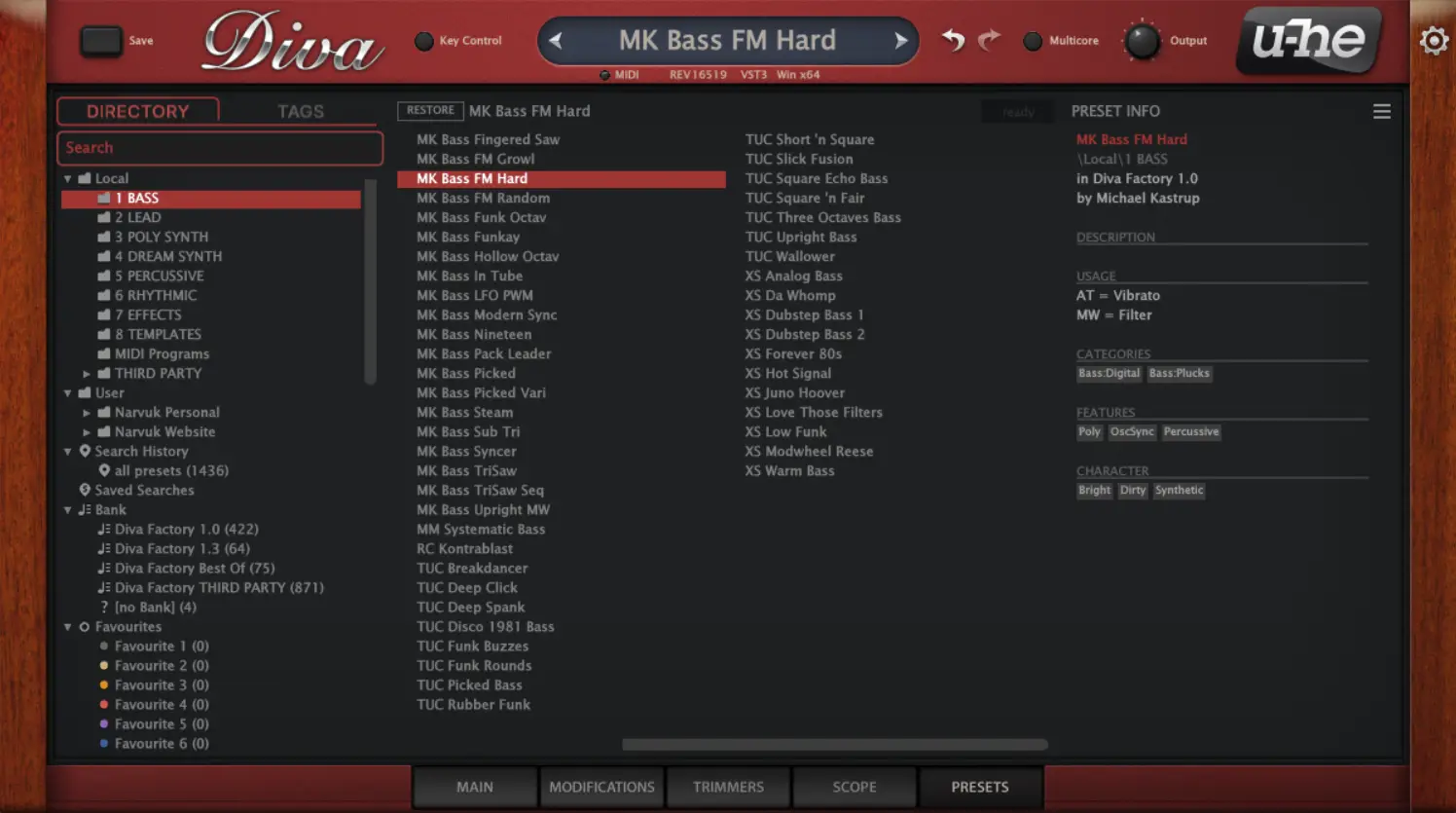
The obvious reason people still talk about Diva is the sound. It has that analog-style richness people mention all the time, but what matters more to me is how that richness behaves inside a real track. It does not just sound pleasant in solo. It tends to give sounds a kind of body and movement that helps them feel more finished with less effort.
I think that is where a lot of synth reviews go wrong. They talk about tone in abstract terms without asking whether the instrument actually helps you build better parts. For me, Diva usually does. Pads feel more alive. Plucks feel rounder and more expressive. Basses can feel weighty without turning into mud straight away. Leads can carry emotion without sounding thin or plastic. That does not mean it is perfect for everything, but it does mean it has a very clear strength.
That strength is not just warmth for the sake of warmth. It is the feeling that the sound already has some internal movement and maturity before I start piling effects on top. In practice, that can save a lot of time.
Why I still use Diva in 2026
The simplest answer is that it still earns its place. I do not really care whether a plugin is old if it still gives me something useful and distinctive. In a workflow full of options, I think that is the real test. Does it do something well enough that you keep coming back to it? Diva does.
For me, it is especially useful when I want a sound to carry more feeling or more musical weight on its own. That could be a melodic line that needs warmth, a chord layer that needs depth, or a supporting part that should feel rich without being overly bright. In those moments, Diva often feels like the instrument that gives me a strong starting point rather than a blank technical shape.
This lines up with the broader way I think about plugins in general. I do not really want more tools just to have more tools. I want instruments that earn a place in the workflow by helping me make stronger records, which is exactly the kind of filter I wrote about in what I look for in a plugin before it earns a place in my workflow. Diva passes that test because it gives me a sound I still genuinely value.
Where Diva fits in my workflow
I would not call Diva my all-purpose answer to everything. That is not really the point of it. If I need extremely surgical sound design, a very specific modern EDM shape, or a super-fast visual workflow, there are other synths I may go to first. But if I want something to feel lush, moody, rounded, or emotionally grounded, Diva becomes much more attractive.
I think it is especially strong for chord work, warmer leads, atmospheric layers, and parts that need to carry tone rather than just attack. It can also work for bass, particularly when the bass needs more character than brute-force aggression. The point is not that it only does one thing. It is that its strongest results tend to live in a certain kind of musical space, and knowing that makes it much more useful.
That is also why I do not compare it too directly to something like Serum 2. The two synths can overlap in some situations, but the reason I reach for them is not identical. Serum is often about precision, flexibility, and modern speed for me. Diva is more about tone, body, and musical weight.
The sound has presence without needing too much repair
One of the things I like most about Diva is that it often needs less rescue work than thinner or more sterile synths. A lot of modern software can sound impressive at first because it is bright, detailed, or huge, but then you start fitting it into the mix and realise it needs shaping everywhere. The sound is technically powerful, but not naturally settled.
Diva often feels more settled to me. That does not mean it drops perfectly into every mix untouched, because no synth does, but it usually feels like it belongs somewhere musical more quickly. The tone feels fuller and more natural from the start. That can be a big advantage when I am trying to keep momentum while writing.
I think this is part of why it is still easy to justify in 2026. Tools that reduce friction while still sounding strong are valuable. They help you stay focused on music rather than endless technical correction.
It suits emotional material really well
Another reason I still rate Diva highly is that it is genuinely good at carrying emotion. That matters a lot to me because even in harder music, I do not want everything to feel cold or mechanical. I want some parts of a track to pull in a bit more feeling, atmosphere, or depth. Diva is very good at helping sounds feel expressive without becoming weak.
That makes it useful for breakdowns, intros, supporting melodic layers, and even certain lead lines where I want the sound to feel warm rather than clinical. It can help create the kind of texture that supports the emotional side of a record without softening the whole track in the wrong way. That is a very useful balance, especially if you care about intensity and feeling at the same time.
In that sense, it fits well with the wider approach behind making a track feel more emotional without softening it. Emotion does not have to mean weakness, and Diva is one of those synths that reminds you of that.
It is not the fastest synth, and that matters
To be fair, Diva is not always the fastest tool to work with. There are synths that feel more immediate if I want to move very quickly through lots of visual sound design options. There are also synths that can feel more obviously modern in the way they present modulation and routing. If speed above all else is the goal, Diva will not always be the first thing I open.
But I also think this is where personal workflow matters. Sometimes a synth being a little less hyper-accelerated is not actually a problem if the sound payoff is better. If I get to a stronger musical result faster because the raw tone is more convincing, then the overall workflow is still efficient. Fast browsing is not the only kind of speed that matters.
That is one reason I try not to judge instruments only by interface trends. The real question is whether they help me reach a sound that fits the track without dragging me into unnecessary work.
Diva versus newer synths
I do think newer synths have advantages. Some are more experimental. Some are broader. Some are cleaner for modern EDM shaping. Some simply do more. But having more does not automatically make them more useful in every musical situation. Diva still holds its ground because it offers something distinctive, and distinctive still matters.
For me, that distinction is not just that it sounds analog-style. It is that it often sounds musically convincing with less effort. In a busy production environment, that matters a lot. If I can get warmth, movement, and character without fighting the sound, that is a real advantage.
That is also why I think it sits comfortably alongside other favourites rather than getting replaced by them. It is not trying to be every synth. It is good at being Diva.
CPU and practicality
It would be dishonest to review Diva without mentioning that it has long had a reputation for being heavier than some alternatives. Depending on the patch and settings, that can still be true. If you are loading a lot of demanding instances, you are going to notice it more than with some lighter options.
For me, though, the question is whether that cost is justified. In plenty of cases, I think it is. If one or two well-chosen Diva parts add real depth and identity to a track, that trade-off can be worth it. I would rather use a heavier instrument with a clear musical purpose than a lighter one that leaves me constantly trying to fake the same result with extra processing.
Still, this is part of knowing your workflow. Diva is easiest to love when you are using it deliberately rather than mindlessly filling an arrangement with instances you do not need.
Who I think Diva is best for
I think Diva is strongest for producers who genuinely care about tone and musical weight, not just feature lists. If you want sounds that feel rich, warm, and slightly more alive from the start, it is still one of the best software instruments around. It is especially good if your music benefits from chords, melodic layers, pads, basses, and leads that need to feel more human and textured.
If you are looking for a super-modern visual playground first, or if you want one synth that tries to cover every possible direction in the most contemporary way, then you may lean elsewhere. But if you want a synth that still sounds beautiful and useful in real records, Diva is very easy to justify.
And if you already make music where emotion, warmth, and tone matter, it is even easier to understand why it still has a place.
Does Diva still deserve a place in 2026?
For me, yes. Very comfortably. Not because of nostalgia, and not because people have talked about it for years, but because it still gives me something that is musically valuable. It still sounds rich. It still helps parts feel more alive. It still earns a place when I want warmth, depth, and character that do not feel fake or forced.
I think that is the right way to judge a plugin in 2026. Not by whether it is brand new, but by whether it still helps you make stronger music. Diva does.
Final thoughts
Diva is not the newest synth in my folder, and it is not the tool I would open for every single job. But when I want a part to feel fuller, warmer, and more emotionally convincing, it is still one of the instruments I trust most. That alone says a lot.
There are plenty of plugins that look modern and sound impressive for a moment. Diva is one of the ones that still feels musically useful after the novelty wears off. For me, that is why it remains relevant. It still helps me make sounds that feel like they belong in the record rather than just in the preset browser.
So if you are wondering whether Diva still deserves a place in 2026, my answer is simple. If you care about tone, warmth, and musical weight, yes, absolutely.
![[Serum 2 Presets] Bass - Deep UNS 0001](/content/images/size/w600/format/webp/2026/05/serum-2-preset-bass-deep-uns-0001.webp)
![[Diva Presets] Dirty Bass 1-4](/content/images/size/w600/format/webp/2026/05/diva-presets-dirty-bass-1-4.webp)


Discussion